Lamond Breachton
The wandering wizard who found fifty people dying in a valley and spent a year pulling them back from the edge. Breachill still carries his name. He left and never came back.
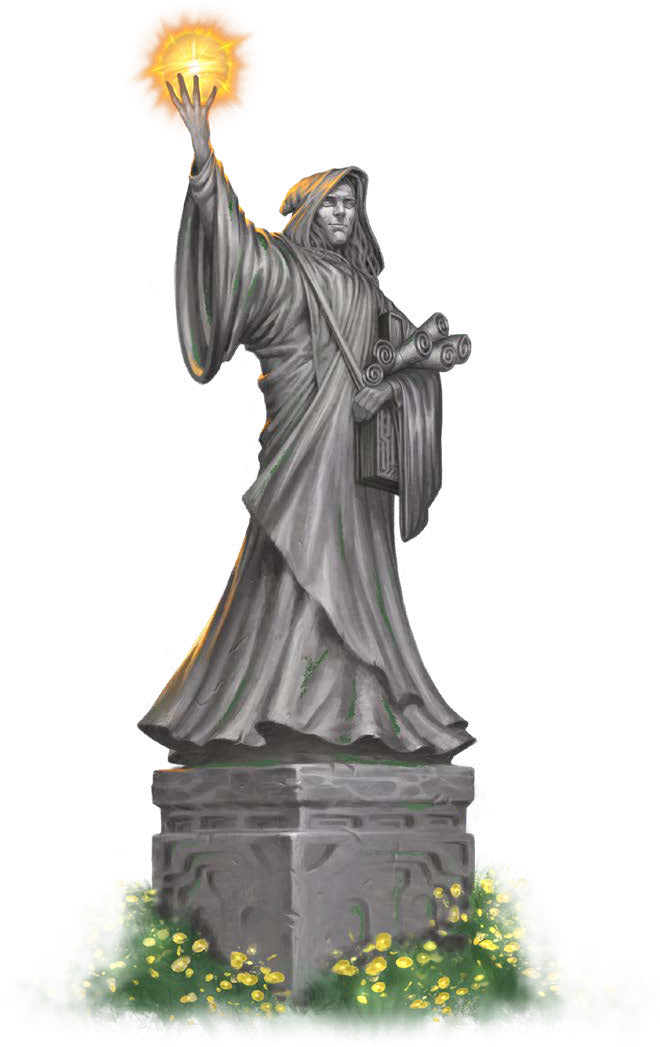
Lamond Breachton arrived in the valley below the Five Kings Mountains in the autumn of 4520 AR and found fifty people who should not have survived the coming winter. They had no collective memory of how they had arrived, little knowledge of who they were to each other, and supplies that would run out before the first heavy snow. He had the means to help. He helped.
That is the shape of the story as Breachill tells it. Within the story's shape, there is room for a great deal that gets left out.
The Founding Year
What the records preserve — such records as exist, pieced together from oral tradition and a handful of documents the town's founders wrote in their later years — is a picture of sustained, practical competence. Breachton did not arrive with speeches. He arrived with timber and coin and, apparently, a working knowledge of exactly how much food a settlement of fifty people required to carry through to the spring thaw.
The shelters he helped build in those first weeks were not hasty constructions. They were sited for drainage and wind protection, insulated against a mountain winter, and laid out with a coherence that suggested someone who had thought carefully about how people live near one another under sustained stress. He brought in seed stock for the following season's planting. He identified which settlers had useful trades and organized them accordingly. He was not, by the accounts, warm in the way a benefactor is expected to be. He was present. He was effective. He did not require gratitude in order to continue.
By spring, the settlement was stable. By summer, it was producing. By autumn of 4521 AR, when the second harvest came in and the population had begun to build something that looked like a future, Breachton was gone.
The Gap in the Record
No account of Breachton describes where he came from, what he was doing in the region when he found the founders, or what brought him through that particular valley at that particular time. He appears in the record fully formed: a wizard of evident wealth, traveling without stated purpose, who encountered a crisis and addressed it. The accounts converge on his competence and his silence about himself.
He did not share his history. The few founders who recorded their impressions note that he deflected personal questions without apparent discomfort — not rudely, but finally. He was interested in the work. He was not interested in conversation about himself. The founders, who had far more pressing concerns in those early months, accepted this without much resistance.
What he told them about his magical practice is similarly thin. He was a wizard. He used his abilities in service of the settlement's practical needs. The specifics are not recorded, which suggests either that the founders lacked the vocabulary to describe what they witnessed, or that Breachton was careful not to demonstrate more than was necessary.
The Name
The founders named the town Breachton's Hill in recognition of his role, later shortened to Breachill. This choice says something about how they understood what had happened to them. A person who saves your life becomes legible as a savior; it is easier to name a town for someone whose function you understand than to sit with the more complicated question of what he was actually doing there and why.
Breachton accepted the honor without ceremony, as far as anyone recorded. He did not argue against it. He did not appear moved by it. He left.
The Veneration Problem
Breachill's relationship to Breachton's memory has hardened over five generations into something that resists examination. In the town's founding mythology, he is a figure of grace: the wandering wizard who found them, built them, gave them a future, and departed. The story is repeated in the Call for Heroes that the town council issues each month, in the charter Breachton himself drafted for democratic governance, in the streets named for him and the murals painted in his likeness.
The murals are a reasonable guess. No one in Breachill has a documented physical description of the man that predates the artwork.
The veneration functions, largely, as a prohibition against scrutiny. Harsh words about the founder are understood as a challenge to residents' honor. Questions about the founding history are received as ingratitude. William's Truth Seeker background had already identified this pattern before the events of Hellknight Hill gave it sharper stakes: the civic identity of a town can be built on a story, and the story can be true in its surface details and still leave out everything that matters.
The Charter
One genuine artifact survives: the founding charter, or a copy of it, in the Breachill town hall. It is a document of unusual sophistication for a frontier settlement — detailed provisions for democratic election, clear delineation of council powers, explicit protections for minority voices within the electoral process. The kind of civic architecture that takes time and precedent to develop, not the kind a spontaneous survivor settlement produces in its first year.
Breachton drafted it. The founders signed it. Whatever else he was or wasn't, he had thought seriously about how people govern themselves. The charter has been amended over 170 years but its core structure remains intact. Breachill runs on it still.
Legacy
Lamond Breachton is most honestly characterized as a problem the town has not had reason to fully solve. He gave Breachill its name, its charter, and its origin story. He stayed long enough to ensure the founders could sustain themselves and left before his presence became complicated. Whatever he was looking for in that valley, or why he devoted a year to people he had no prior connection to, he took the answers with him.
The party has learned enough about Breachill's founding to know the surface story is incomplete. What that incompleteness ultimately means — for the town, for its people, for the chain of events that began when fifty strangers found themselves in a mountain valley with no past — is a question that has not been answered.