William Hales
A Champion of Liberation devoted to the goddess of beauty and love — who trained in Deception and chooses, deliberately, when not to use it.
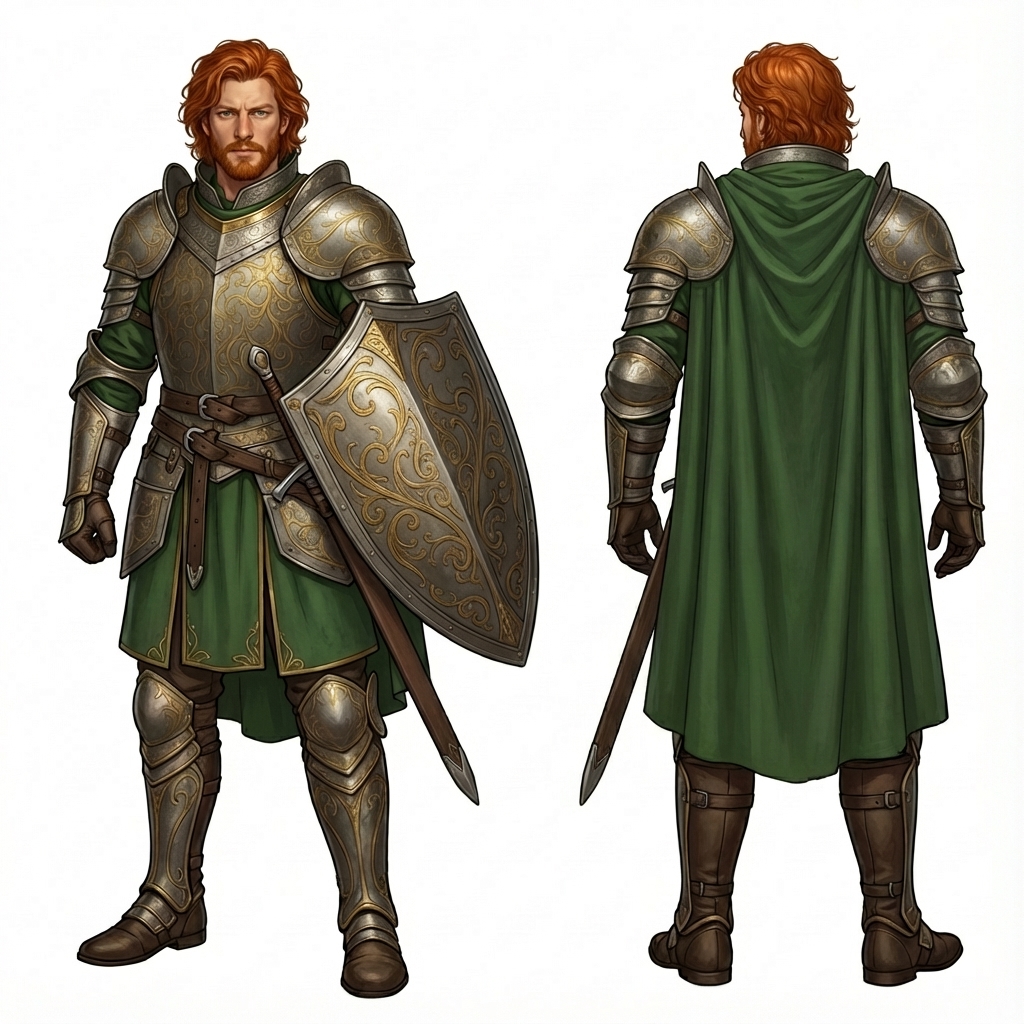
William Hales is a broad-shouldered man with medium reddish hair, wearing half-plate and carrying more weapons than most people think necessary. Shelyn's symbol sits plainly at his collar: not hidden, not displayed for effect, just present. He tries not to stand out. He keeps his shield strapped and his sword within reach, and after a fight he cleans the blade before he speaks to anyone.
Truth Seeker
William suspected from the start that Breachill's founding story was too clean. The amnesiacs, the generous wizard who appeared exactly when needed, the complete absence of prior documentation: it bothered him. His training in Deception and Politics Lore makes him the party member most aware of the space between what people say and what is true. He came to Breachill specifically because he wanted access to the council records.
He chooses honesty. That is the important part. He knows how to deceive, and he makes a deliberate decision about when that knowledge is and is not appropriate.
Beyond this background, William's personal history is almost entirely open. Where he trained, who his mentor was, what shaped him before Breachill: none of this has surfaced. He is characterized through behavior and stated values rather than backstory. That territory remains available.
Personality
William leads by doing rather than by directing. He is consistently the first through the door, literally and figuratively. He opens doors cautiously and checks situations, but he opens them first. His tactical role as a Champion shapes his personality: he thinks in terms of position and protection, and he extends that spatial logic to relationships. He places himself between threats and allies in combat; he places himself between bad options and his party in conversation.
He has a dry, understated humor that sits beneath the formal surface. "As long as the cultists aren't the ones we're feasting on" is a good example: deadpan delivery on a grim joke.
He is confident without performing it, diplomatic by inclination, and attentive to whether the people around him are holding up.
He is also genuine in his religion in a way that is easy to overlook because it is not performative. He prays quietly when the fighting is done, "his thoughts mainly on Renali and the coming dealings with the Triad." He formally thanks the gods after a hard battle. These are private practices.
Liberation Cause
William's Champion cause is Liberation: protecting people from oppression, imprisonment, and coercion. His Champion's Aura and Liberation reaction protect allies from oppressive effects; he is frequently the difference between someone being restrained and someone being free. Fighting a slave-trading organization with a Liberation Champion is not subtle thematic territory. It is, however, accurate.
Shelyn's portfolio adds a specific quality: love, beauty, art, the things that cannot exist under oppression. A society built on slavery produces nothing worth protecting.
Values
William's values are grounded in protection and right action, held with conviction rather than flexibility. When he encountered the enslaved birds: "These birds very obviously don't like being here but they don't seem to have a choice… There must be a way to free them." The phrase "there must be a way" is characteristic. He does not accept the premise that wrong things are permanent. This applies to undead ("root it out and free those poor souls"), enslavement, and deception: "I don't want to hear about fairness from a devil."
He offers surrender before violence consistently: "Surrender and no one needs to die!" He is not naive about whether the offer will be taken up. He does it anyway. It is a ritual acknowledgment that violence is the last tool rather than the first.
He holds teammates accountable in a low-key way. He will remind people when they have tactical options. He will gently correct plans that he thinks are unwise. He does not overrule, but he adds friction where he thinks it is needed.
Voice
William speaks with moderate formality. He uses respectful titles ("Miss President") and full sentences, but his delivery is direct rather than elaborate. He does not philosophize. His statements are often functional: "If we don't clear the area, we leave ourselves open to being attacked from behind when we leave." He speaks in terms of consequences and objectives.
He has a pattern of framing problems as solvable. "There must be a way to free them." "If the bear belongs to the Bumblebrashers, would it not be a better idea to get them to retrieve their lost pet?" These are reframes, offered calmly and without insistence. He presents alternatives; he does not fight for them. If the party goes a different direction, he follows.
His voice is more compressed than Frazzle's or Theo's. He says what he needs to say and stops. Short declaratives and questions dominate: "We are after a Human that came towards this keep, and to find out what happened to the local Goblin Tribe, we otherwise have no desire to steal from you." One sentence does the work of a paragraph because every component is load-bearing.
"These birds very obviously don't like being here but they don't seem to have a choice… There must be a way to free them."
"If necromancy is involved, we should root it out and free those poor souls of their torment."
"Surrender and no one needs to die!" (His standing opening offer)
Arsenal
William carries more weapons than most, calibrated for what he might face:
- Ghost Touch longsword, for incorporeal threats
- Cold Iron glaive, for fey and demons
- Silver flail with Vitalizing rune, for undead
- Rooting sap, for situations requiring restraint
This is not indecision. It is preparation.
Devotion Spells
Shields of the Spirit. He keeps people standing. He keeps them from being taken. In his faith, those are the same thing.
Relationships
William and Nadira are the functional core of the party. They do not talk about their relationship much, but their combat behavior shows a well-practiced partnership: she buffs him, he protects her, they move in concert. Out of combat he defers to her knowledge of healing and religion; she defers to his tactical lead in combat. Neither resents the other's domain.
With Theo he has good-humored respect. With Frazzle he listens carefully to diplomatic proposals and gives them real weight, even when he does not follow them. He said "Dragonkin, we are not your enemies, do you require assistance?" when the party encountered the kobolds in Mwangi: he remembered the Bumblebrasher kobolds from earlier and applied that prior relationship as context. He does this kind of pattern-matching consistently.
He is carrying grief about Renali but has not yet had the space to process it. His prayer ("his thoughts mainly on Renali and the coming dealings with the Triad") is the closest thing. That grief is available for use.
DM Notes
William's values are stable and have not been seriously tested. He has offered mercy and been refused. He has encountered necromancy and undead. He has protected innocents. But he has not been put in a position where protecting one innocent means abandoning another, where Shelyn's values of beauty and compassion conflict with his role as a warrior, or where the right action is ambiguous in a way that his theology cannot resolve.His Shelyn devotion is the least-explored faith in the party. Shelyn's portfolio includes art, music, and romantic love, none of which have surfaced in the events so far. A situation that engages those softer dimensions of his goddess would reveal whether William understands Shelyn as a patron of beauty-in-general or specifically as a counterweight to his martial nature. An NPC artist, musician, or romantic figure under threat would test what he believes his goddess is asking of him.