The Cinderclaws
A Dahak-worshipping cult of boggards and charau-ka that held the Mwangi Expanse in its grip until the party dismantled it, one dragon pillar at a time.
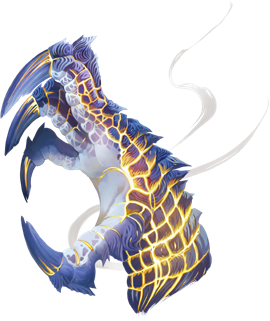
The Cinderclaws are not an old institution. They are the latest in a long series of Dahak cults that rose within the shadow of Huntergate, drew strength from the imprisoned god's leaking influence, and were eventually ground down by the Ekujae. What set the Cinderclaws apart was Belmazog: a half-dragon boggard with the ambition to do what every previous cult leader had failed to do, and access, for the first time, to outside resources capable of matching the scale of her vision.
Before the party arrived in the Mwangi Expanse, the Cinderclaws had already accomplished something unprecedented. They had blinded the Ekujae.
Origins
The manifestation of Dahak that the Ekujae drove through Huntergate millennia ago never fully went away. Sealed between realities, unable to escape, it has nevertheless bled outward for centuries: subtle, persistent, a slow contamination of the land around the gate. Dozens of cults rose from that contamination, each one finding the energy and the mythology ready-made. Each one was eventually destroyed.
Belmazog came to her faith through dreams. She is a boggard — squat, amphibious, built for swamp and ambush — but she carries dragon blood, a fact she understood as a mark of Dahak's favor from the first time she felt it. When the god's manifestation began calling to her from the deep swamp east of Huntergate, she went. When she found the fossilized remains of Dahak's physical body, enormous and half-submerged in black water, she built her congregation around the bones.
The cult that formed was diverse by the standards of such organizations. Boggards formed its core, loyal to Belmazog through a combination of religious conviction and personal fear. Charau-ka — the ape-like humanoids of the deep jungle, already savage and already drawn to draconic power — joined in numbers, providing the cult's most capable fighters. The fossil of Dahak's manifestation served as the congregation's temple and rallying point. For years, the cult was contained: a threat the Ekujae monitored, a nuisance they could not eliminate without triggering the god's defensive magic, but nothing more.
Then the Scarlet Triad made contact.
The Scarlet Triad Arrangement
The Triad was not interested in Dahak's theology. They were interested in a fragment of the Orb of Gold Dragonkind and the particular resonance that Dahak's trapped manifestation could provide for its repair. Belmazog was the means to an end: a cult leader who controlled the territory around Huntergate, who could mine the region's arsenic-laced gold under the guise of religious devotion, and who could be handed enough ritual power to actually threaten the Ekujae.
The arrangement was simple by Triad standards. Belmazog received the nul-acrumi vazghul, a ritual of Necril origin repurposed by Triad wizards to work through Dahak's fossilized remains. She received Triad-built golems and logistical support for the construction of her fortress. She received access to a captive red dragon — Kyrion, taken by force — to serve as the living focus that made the ritual's full effect possible.
In exchange, she shipped gold.
Belmazog never questioned the arrangement. She had what she needed. The Triad had what they needed. That the scales were tipped toward the Triad's benefit was not a problem she was designed by ambition or temperament to notice.
The nul-acrumi vazghul, once cast with Kyrion as its focus, did what the Triad promised. It blinded every Ekujae within fifty miles of the Fortress of Sorrow. It raised eight dragon pillars across the jungle, each one a complex magical hazard and a component of the protective shell around the cult's headquarters. And it empowered Belmazog's followers with a fraction of Dahak's divine energy, making them faster and harder to kill than they had any right to be.
The Dragon Pillars
Eight pillars. Eight colors. Eight hazards placed across the jungle as a defense-in-depth that forced any assault on the fortress into a dismantling campaign first.
Each pillar was ten feet tall and carved from jungle wood into a dragon's visage. Each broadcast a different wavelength of draconic energy as an active attack against anyone who came too close. The pillar the party encountered in each hex was not merely a guardian; it was also a component of Dahak's Shell, the prismatic dome of energy that surrounded the Fortress of Sorrow itself. As long as all eight pillars stood, the shell was essentially impenetrable. As the party destroyed pillars, colors dropped from the shell, until the dome was weakened enough to breach.
The Cinderclaws maintained guard forces at each pillar: boggard swampseers, charau-ka warriors and butchers, other jungle predators that had been pressed into service or simply drifted to the cult's territory. The forces were not coordinated in any tactical sense. They were present. That was often enough.
The Fortress of Sorrow
Belmazog named her headquarters after Sorrowmaker, one of Dahak's titles. The name fits the structure: a squat red-clay fortress built atop a granite slab thrust up from the swamp floor, surrounded by standing pillars topped with open flame, and constructed partly from the fossilized bones of the god the Cinderclaws worship.
The cult lived inside their god. The structural portions of the fortress made of Dahak's remains were invulnerable to damage. Belmazog's inner sanctum was built around Dahak's skull itself. Kyrion the dragon was impaled on a shard of the Orb within that room, kept alive, kept in pain, kept as the ritual focus that sustained everything.
The fortress held a forge, a dormitory, a kitchen, a holding pen for creatures the cult collected from the surrounding jungle. It had a clay golem in its main hallway, a Scarlet Triad gift, set to destroy any intruder who could not pass as a cultist. Sweettooth, a deinosuchus of unusual size, patrolled the swamp outside and was both a pet and a weapon.
It was also, in the end, a trap that Belmazog built for herself. A position that required the Ekujae to be blind, that required the dragon pillars to hold, that required the Triad's continued support. When all three conditions failed at once, the fortress became what it looked like from the outside: a building made of old bones in the middle of a swamp.
Belmazog
The cult's leader and its animating intelligence. A boggard half-dragon who had believed since childhood that her blood was divine purpose made flesh.
Belmazog was not a fanatic in the raving sense. She did not preach; she planned. She thought in terms of leverage and positioning. She had built a cult, secured outside patronage, blinded the Ekujae, constructed a fortified headquarters, and established a mining operation all before the party arrived in the Mwangi Expanse. Her theological conviction and her tactical capability were not in tension. Each reinforced the other.
She died in her sanctum, in the room built around Dahak's skull, with Kyrion still chained beside her.
The Cult's End
The Cinderclaws' defeat came in stages.
The party destroyed the dragon pillars one by one across the jungle, weakening Dahak's Shell with each. They crossed the swamp to the Fortress of Sorrow, passed through the shell with whatever remained of it, and fought their way inside. They freed Kyrion, which broke the nul-acrumi vazghul and ended the blindness on the Ekujae. They killed Belmazog.
The leaderless survivors dispersed. Some were already scattered: a detachment of Cinderclaws had passed through Huntergate during the party's earlier transit and been trapped in the space between when the gate went dark. Others simply retreated into the jungle. Without Belmazog's planning and the Triad's support, there was no mechanism to hold the organization together. The Cinderclaws exist now as individual survivors, not as a functioning cult.
The Ekujae regard the organization as finished. The Scarlet Triad has moved on to its next instrument.
Aftermath and Legacy
Kyrion is free. The Orb of Gold Dragonkind fragment the Triad sought is no longer secured at the Fortress of Sorrow. The blinding ritual is broken. The Ekujae's access to the territory around Huntergate has been restored.
The gold the Cinderclaws mined is somewhere in Scarlet Triad possession, processed into whatever form the Triad's artifact-repair project required. The party did not stop that extraction. They stopped the cult. The Triad's broader plan continued.
What the party earned from the Ekujae was recognition as kelesi: honored outsiders who had done something the elves' own warriors could not, because the Ekujae could not get close enough to do it themselves. The title is permanent. It carries obligations as well as standing, in the way that Ekujae gifts usually do.