Nadira
A warpriest of the Dawnflower, plagued by visions of fire — and drawn to Breachill by the sight of a town burning before it happened.
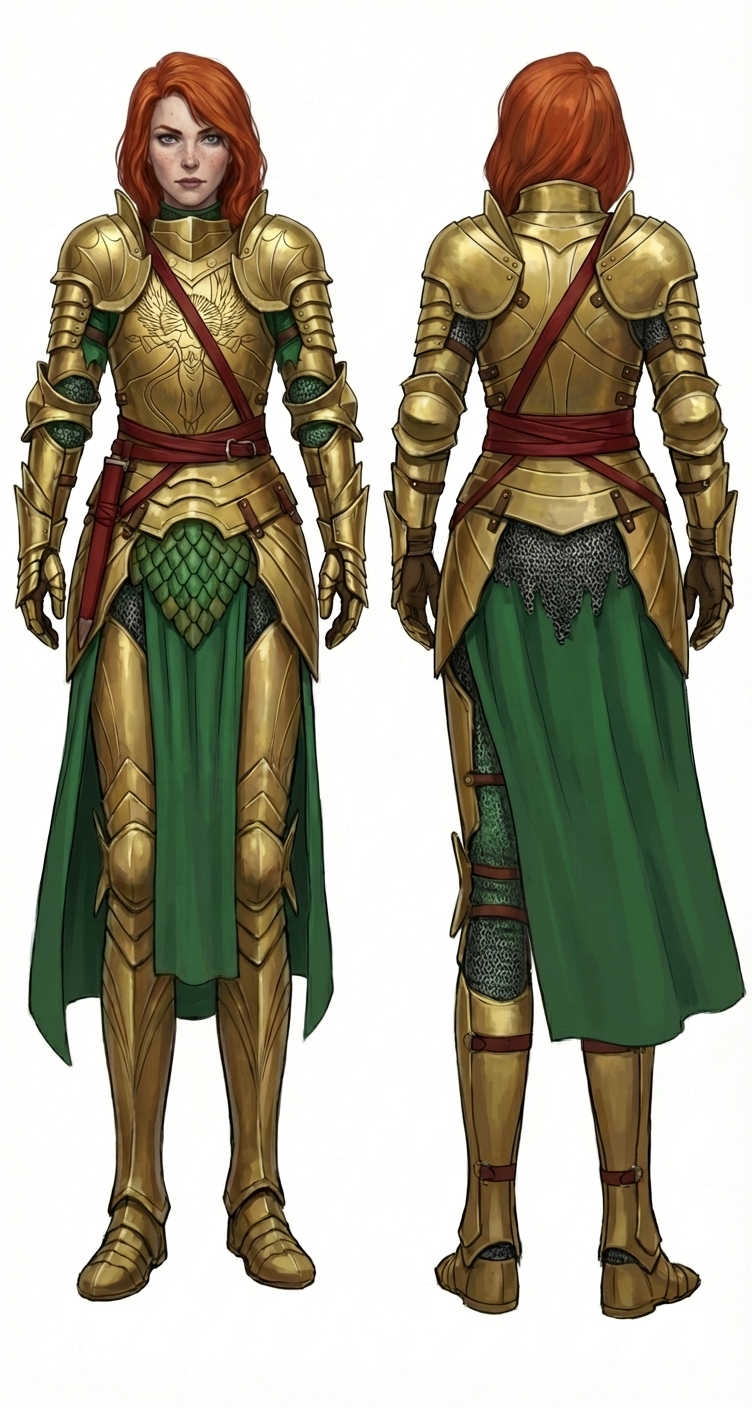
Nadira is a warpriest: a cleric who wields her faith as a weapon, not a comfort. She wears armor marked with Sarenrae's symbols and carries her holy symbol openly. Those who know the Dawnflower's sigil recognize what they are looking at.
Haunting Vision
Nadira has been plagued since young adulthood by prophetic dreams of fire, all connected in some way to Dahak, the dragon god of destruction. These were not warnings so much as invitations she could not refuse. The vision that drew her to Breachill was specific: a town burning. She arrived to answer the Call for Heroes before she fully understood why she was there.
Dahak's influence shaped the conspiracy at Hellknight Hill and the central conflict in Mwangi. Nadira's visions may not be finished.
Origin
An orphan of the church, raised by a travelling warpriest, trained in both healing and combat. She stated this biography to the Ekujae when asked. It explains her combination of gentleness and firmness without requiring elaboration during play.
Personality
Nadira is the party's pragmatist. She has the strongest action orientation of the four: she identifies a problem, states what she is doing about it, and does it. When prisoners need tying up: "Nadira is going to walk over and very thoroughly tie up Ammin." When the town needs news: "Nadira goes back to the boat and lets the townspeople know it's safe, it's over." She rarely asks whether she should act. She acts and reports.
She is the party member most willing to voice frustration directly. She does not perform equanimity. This is a consistent trait: she says what she means.
She approaches problems by identifying the human (or creature) element first. In the Goblinblood Caves, rather than examining the space tactically, she opened with: "You've been alone down here a while, haven't you?" That emotional attunement shapes her problem-solving. She reads motivation before she reads threat level. Her working theory of behavior: "Hunger drives the rational to do irrational things." She applies it consistently.
Values
Sarenrae's portfolio is redemption, healing, and the honesty of daylight. Nadira carries all three into her play, but they exist in real tension. She will offer food to starving enemies. She will also insist that Amnan specifically not be released: "I do not want to see Amnan in particular be just let go." The compassion and the insistence on accountability are not contradictory. They are both expressions of the same theology, which holds that some people choose evil with full understanding, and that protecting the innocent sometimes means ensuring consequences.
Her original motivation (the vision of catastrophe she understands as Sarenrae's warning) has driven her from the beginning. She is not in this for coin or glory.
She values competence in her allies and will say so. She is generous with information. She acts like someone who expects the group to function well and is actively working toward that end.
Her sense of duty sits above institutional authority. When the Breachill council's approval was uncertain, her position was uncomplicated: their support would be helpful, but she would investigate regardless. Duty does not require permission.
Combat Doctrine
As a Warpriest, Nadira's martial and divine abilities are fully integrated. Her favored weapon is a +1 Striking Flaming Cold Iron Scimitar: Sarenrae's symbolic fire, practical metallurgy for fighting fey and demons, and the reach to make choices count.
She carries a bow for situations that require distance. She has Battle Medicine for situations that require neither sword nor spell, just fast hands and a steady mind.
She can sanctify water and channels vitality energy rather than void. Against unholy creatures (demons, devils, the kinds of things the Scarlet Triad deals with) she is particularly dangerous.
Voice
Nadira's voice is plain, direct, and warm without being effusive. Her sentences tend to be short to medium length and declarative. She does not ornament. Compare her address to the Ekujae leaders ("I am a warpriestess of Sarenrae. I presume you know what that stands for") to Frazzle's longer, more philosophical self-presentation in the same scene. She states her identity as a credential and moves on.
She uses Sarenrae's name with precision, invoking it as framing rather than decoration: "I am a priestess of Sarenrae. I presume you know what that stands for. I will do my best to ensure he sees proper justice." The name does real work: it is a promise and a statement of jurisdiction simultaneously.
Her rhetorical habit is to pair a problem-statement with a solution in the same breath: "I do not want to see Amnan in particular be just let go." No elaboration. The judgment is complete. She is also capable of warmth: "Wee! The sky looks pretty," a moment of simple, unironic delight early on, before things got dark, that reveals the person underneath the warpriest.
Her mercy has a hard limit. "They chose to fight to the death. You cannot redeem those who will not see reason. Their destruction is a regrettable necessity." That is the Dawnflower's doctrine spoken by someone who means it.
"You're clearly starving. Hunger drives the rational to do irrational things." (To enemy prisoners)
"We will take them with us. They can pay for their sins back in Breachill."
"What's stronger than a dragon? A dragon with friends." (Making a pitch for alliance to the kobold Pib)
Relationships
Nadira has the most developed functional relationship with William. They operate as a combat unit: she buffs him, he shields her, they move in concert without discussion. Off the battlefield she sometimes gently corrects him ("Suppose I could have warned you") but treats him as a full peer. With Theo, she has a collegial dynamic: they exchange tactical information, she trusts his assessments. With Frazzle, the relationship is still forming; she collaborates on plans but the interpersonal texture is thinner than her relationships with the originals.
The loss of Renali (the party's ally whose soul was taken by the Kalavakus demon) affected Nadira visibly. She is the one who describes what happened to the Desna priestess: "We lost one in combat against it, and while we defeated the demon, her soul went with it." She takes on the burden of explanation and the task of seeking remedy. She feels responsible for the party in a way that extends beyond her role as healer.
DM Notes
Nadira's characterization is the most consistent, which means its gaps are harder to spot. The tension in Sarenrae's theology (between redemption and consequence, between mercy and the hard light of honesty) surfaces in her actions but has never been fully dramatized. Put her in a situation where the person she is trying to redeem is genuinely redeemable but would also cause catastrophic harm if freed. Ask her whether her goddess's mercy can be weaponized and whether that changes its nature.She is also an orphan with no stated family, no homeland beyond the church, and no clear understanding of how she was lost. That is a backstory hook that has never been touched. A figure from her early life (not necessarily the travelling warpriest who raised her, but someone adjacent to that period: a sibling-in-faith, a person she wronged, a person who knows what happened to her family) would hit differently than any external threat.