Alseta's Ring
A ring of six aiudara beneath Citadel Altaerein, older than the nations above them, and host to a power that has been waiting since Earthfall.
Overview
Alseta's Ring is a network of six elven portal-gates — aiudara — located in the caverns beneath Citadel Altaerein in Isger. They are among the oldest aiudara ever constructed on Golarion, built in the Age of Legends by the elven spellcaster and hero Candlaron. He arranged the portals in a ring formation, positioning each as close to the others as their portal energies would allow without interfering with one another. This spatial experiment proved historically significant: the insights gained from constructing the Ring led directly to Candlaron's later breakthrough in designing aiudara hubs capable of linking more than two locations simultaneously.
By the time of Earthfall, the Ring had grown obsolete — the hub mechanic made its configuration inefficient, and it had long since become little more than a curiosity. The catastrophe that followed Earthfall changed that permanently.
The Ring takes its name from Alseta, the goddess of transitions, doors, and thresholds. Each gate within the Ring was dedicated to a different elven deity, a practice that served both as tribute and as a means of imbuing each portal with a distinct character.
History
The Age of Legends
Candlaron constructed Alseta's Ring during the Age of Legends as part of his early research into portal-gate architecture. The six aiudara were intended to connect disparate locations across Golarion, each gate dedicated to an elven deity and built with a distinct aesthetic reflecting that deity's domain. A way station — a small self-contained demiplane — exists between each portal's two exits, providing travelers a place to pause between transit points.
The Ring served active use for a period before the more efficient hub aiudara Candlaron later developed drew traffic away from it. By the eve of Earthfall, the portals had been largely abandoned.
Earthfall and Dahak's Intrusion
When Earthfall struck Golarion, the god of destructive dragon-kind, Dahak, saw an opportunity. Concealed beneath the overwhelming devastation of that era — with continents reshaping and lesser deities being destroyed — Dahak could act without drawing the wrath of his father, Apsu. After years of searching the metaphysical boundary between his divine realm and the Material Plane, Dahak discovered a structural flaw in one of the Ring's first-constructed portals. Using it, he eased a sliver of his essence through the boundary and manifested a powerful incarnation of himself in the post-Earthfall world.
This incarnation spent years ravaging the weakened world, producing events known as dragonstorms — long-lasting catastrophes incorporating all five chromatic breath weapons: lightning strikes, fiery tornadoes, freezing blasts, acidic rain, and poisonous fog. The storms also drove all dragons within their radius into a primal frenzy, turning them against one another. Golarion, already devastated by Earthfall, was in danger of being finished entirely.
The Anima Invocation and Dahak's Imprisonment
The Ekujae elves of the Mwangi Expanse, who had remained on Golarion hoping to endure the disaster, intervened. Drawing on partial knowledge of how the aiudara functioned, they performed a powerful ritual called the Anima Invocation, sacrificing many of their greatest heroes to turn Dahak's destructive power back in on itself. The ritual slew the incarnation's physical body and banished its spiritual essence into the metaphysical space between the portals of Alseta's Ring — trapped beyond reality, bodiless but not destroyed.
The magical backlash of the ritual was severe. It blasted through the portals and destroyed Lotusgate, the gate connecting the Ring to Kyonin. With Lotusgate shattered, Alseta's Ring was severed entirely from the broader aiudara network. By the time elves returned to Golarion thousands of years later, the Ring and the imprisoned incarnation within it had been completely forgotten.
Rediscovery
How or when the Ring was rediscovered in the modern era is not fully known to the party. What is clear is that by the time the Cinderclaw cult entered Isger, multiple parties were already aware of the Ring's existence and strategic value. The Scarlet Triad — a slaving organization based in Katapesh — had positioned agents near portal sites across the world, apparently intending to use the Ring's gates as both a transit network and a weapon, directing Dahak's imprisoned fury at locations they wished to destroy or destabilize. Voz Lirayne, a bookseller in Breachill, had been corresponding with Scarlet Triad contacts and conducting her own research into the Ring's nature and location at the time the party encountered her.
The Cinderclaw cult, worshippers of Dahak based in the Mwangi Expanse, activated Huntergate using a stolen portal key and sent their vanguard through to Altaerein. Their invasion was stopped before the rest of the cult could follow.
Current Status
The Ring is in partial operation. The party, as legal custodians of Citadel Altaerein, have claimed stewardship of the Ring and its way stations. Two gates have been unlocked and traversed. The imprisoned incarnation of Dahak, weakened but not eliminated, remains a presence within the network's metaphysical space.
The Gates
Each gate in Alseta's Ring is a stone archway whose interior fills with shimmering mist when activated by its corresponding portal key. The portal remains open for 10 minutes before closing. From within a way station, both exits remain accessible at all times. Once a creature passes through to either side, the portal closes behind them and must be reactivated to use again.
Huntergate
Deity: Ketephys (elven god of the hunt, the moon, and the forest) Destination: A ruined temple of Ketephys in the Mwangi Expanse Portal Key: The hunter's arrowhead Status: Unlocked
Huntergate is the gate through which the Cinderclaws entered Altaerein. It contains the structural flaw Dahak originally used to push his incarnation into Golarion, and the Cinderclaw passage overtaxed that flaw, pulling the portal's magic out of alignment. The way station within is a scorched lava tube — a 20-foot-wide, hundred-foot-long passage between the two archways, its stone walls uncomfortably warm and the air heavy with smoke. Almost nothing of the original décor survives. The temperature within sits at roughly 100°F; the heat is a direct result of Dahak's imprisoned essence, which remains most active here.
The Mwangi Expanse exit once opened into an open-air temple of Ketephys ringed with animated plant guardians and enchanted wildflower hazards. The Cinderclaws burned the garden to nothing before their assault.
Dreamgate
Deity: Desna (goddess of dreams, stars, and travelers) Destination: Northern Ravounel, near the Nidalese border, on Avistan's western coast Portal Key: Eclipse, a magic starknife Status: Unlocked
Dreamgate was dedicated to Desna and intended to be a place of safe rest and pleasant dreaming for travelers. Its way station contains two dreaming chambers, their stone walls and ceilings carved with stars and butterflies, the tiny star reliefs glowing softly to provide dim light. Sound is muffled between chambers — a design choice meant to protect sleeping travelers, though it also means combat in one room does not automatically alert inhabitants of the next.
The way station has long since been claimed by a hag coven. Decades ago, a night hag named Abelstia discovered the demiplane through the Ethereal Plane, drawn by residual dream-related magic. She realized the dreaming chambers allowed her to pass between the way station and the Ethereal Plane using her dream haunting ability, and established the site as her coven's refuge. When she later tried to block the portals to prevent intrusion, the magical backlash killed her. Her surviving covenmates recruited a replacement and have since maintained the way station as their own territory, the Desnan décor long since warped toward nightmares.
Jewelgate
Deity: Yuelral (elven goddess of magic, especially as expressed through crystals and gems) Destination: Unknown Portal Key: Unknown Status: Not yet activated
The arch is carved with imagery associated with Yuelral — crystals, gems, and the iconography of elven magical study. Beyond the dedication observable from the stonework, what lies on the other side of this gate and what key is required to open it remain unknown to the party.
Duskgate
Deity: Findeladlara (elven goddess of architecture, art, and twilight) Destination: Unknown Portal Key: Unknown Status: Not yet activated
Duskgate was the last of the six gates Candlaron built, and the increased artistry visible in its stonework reflects his refined skill at that late stage of the project. It was dedicated to Findeladlara as a monument to elven craft and is decorated with friezes, frescos, and intricate tile mosaics throughout. Where it leads and what opens it are not yet known to the party.
Vengegate
Deity: Calistria (elven goddess of trickery, lust, and revenge) Destination: Unknown Portal Key: Unknown Status: Not yet activated
The arch bears Calistrian iconography — the wasp, the whip, the honeycomb. Beyond the deity dedication readable from the carvings, the gate's destination and required key remain unknown to the party.
Lotusgate
Deity: Unknown Destination: Kyonin Portal Key: Unknown; likely destroyed Status: Destroyed
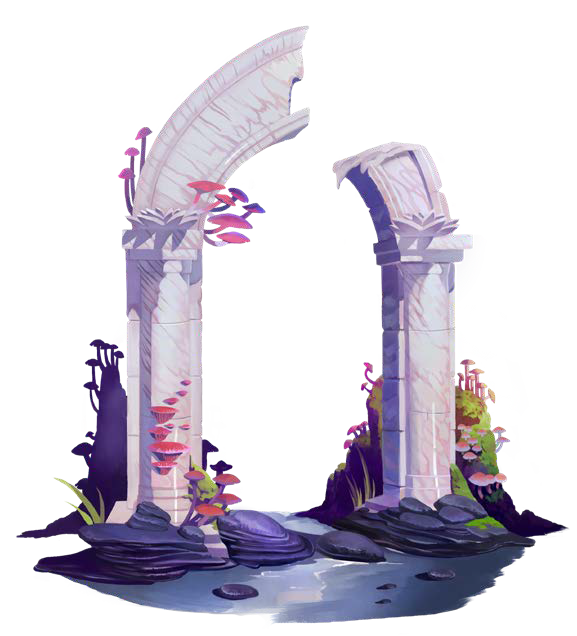
Lotusgate was the gate connecting Alseta's Ring to Kyonin. It stood opposite Huntergate within the Ring's physical arrangement. During the Anima Invocation performed by the Ekujae elves to imprison Dahak's incarnation, the magical backlash from the ritual obliterated Lotusgate entirely. Its destruction severed Alseta's Ring from the broader aiudara network and ensured that elves returning to Golarion after Earthfall would find no path back to the Ring. No key or physical remnant of this gate is known to survive.
Dahak's Imprisoned Manifestation
The incarnation of Dahak trapped within Alseta's Ring is not Dahak himself — it is a fraction of his divine essence, manifested into the world and then stripped of its physical form. It exists in the metaphysical space between the portals, without a body but not without awareness or influence. Over the millennia since its imprisonment, it has learned to manipulate the portal energies to some degree, most noticeably through the corrupting influence it exerts on way stations and the hazardous vision of itself it can project within Huntergate's damaged tunnel.
The Anima Invocation that imprisoned it was not designed to destroy it. The Ekujae elves who performed the ritual understood this limitation. A sufficiently powerful and refined version of the same ritual — one powered by enough perfected souls or sufficient divine opposition — could potentially do more than trap the manifestation. Whether anyone has seriously pursued that possibility, and at what cost, is not yet known to the party.
The manifestation remains weakened following events in the Mwangi Expanse, but it is not gone.
The Way Stations
Each gate in Alseta's Ring contains a small demiplane between its two exits. These way stations are self-contained: they exist outside the normal flow of space, cannot be accessed except through the portals that connect them to Golarion, and cannot be escaped by teleportation unless the effect is capable of interplanar travel. Time passes normally within them. Their physical size is limited to what is visible — attempts to dig through surrounding stone reveal only more stone beyond.
The way stations the party has entered were each built to reflect the deity to whom their gate was dedicated. Neither has been maintained since before Earthfall, and both showed signs of occupation or corruption by forces that arrived long after Candlaron's elves departed. Whether this pattern holds across the other stations is not yet known.